EPSO AD5 2026: reasoning tests first after the official amendment
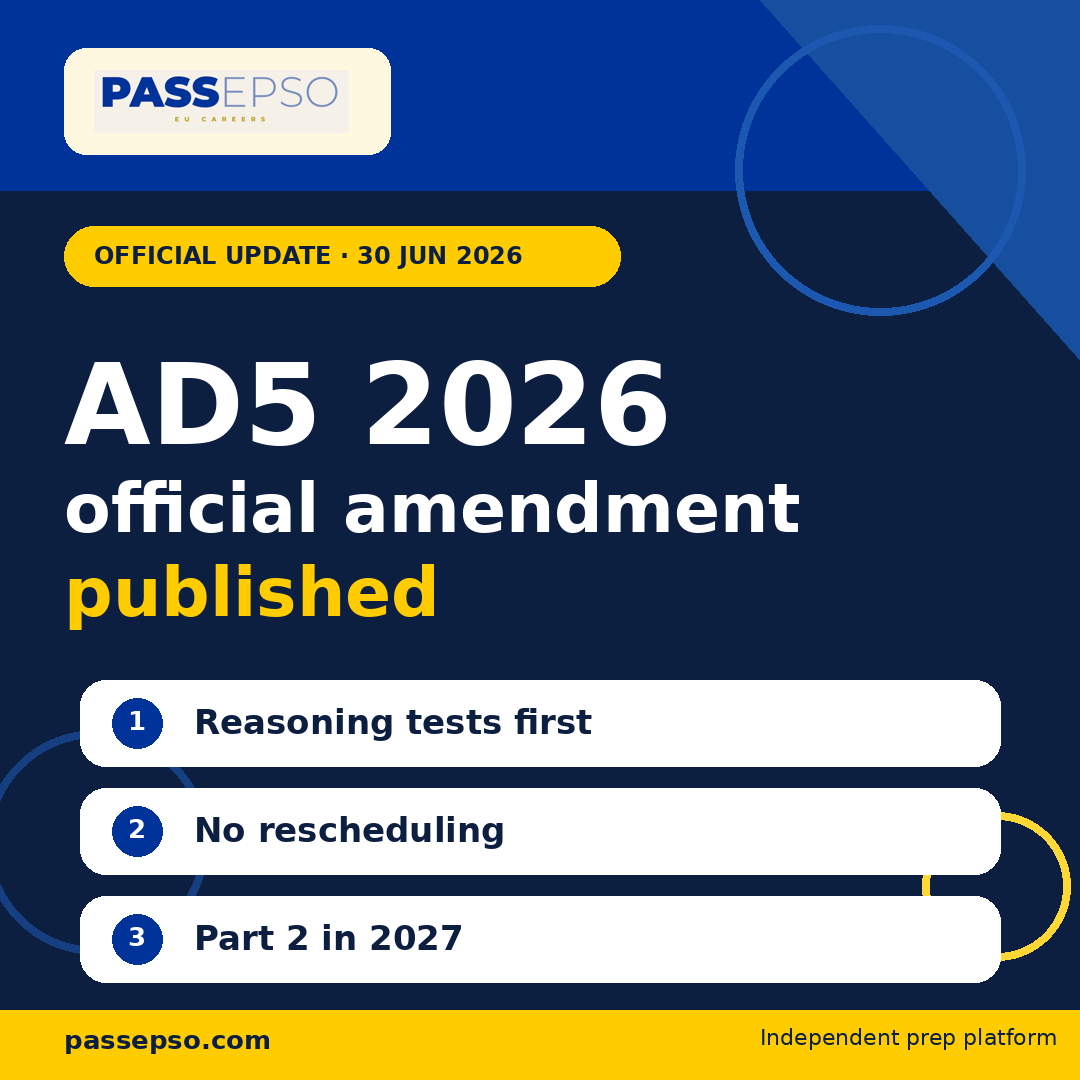
EU Careers published an amendment to the EPSO AD5 2026 notice on 30 June 2026. The practical effect is simple: candidates will no longer sit the AD5 tests in one block. The competition is now organised in two parts, with the reasoning tests first and the remaining tests later in 2027.
This update matters because it changes the preparation order. The first gate is now verbal, numerical and abstract reasoning. EU Knowledge, Digital Skills and the EUFTE written test remain essential, but their sitting is later.
Official sources: EU Careers' 30 June 2026 AD5 update and the official Graduate administrators competition page.
What changed in the AD5 2026 amendment?
EU Careers states that the AD5 Graduates testing procedure is now split into two parts. Instead of sitting all tests at once, candidates complete the competition tests in two separate sittings.
Part 1: reasoning tests first
Part 1 covers the reasoning tests:
- Verbal reasoning
- Numerical reasoning
- Abstract reasoning
EPSO's news item of 13 October 2026 states that the first part of the testing takes place during the week of 9 to 13 November 2026. Each candidate sits all three reasoning tests during a single testing session on one day, and the date and time of that session appear on the TAO testing platform rather than in the invitation letter.
Not every candidate will sit on the same calendar date. EU Careers explains that candidates will be scheduled on different dates throughout the testing period, and that each candidate will receive an individual invitation letter several weeks in advance with the exact date, time and practical details.
Rescheduling Part 1 will not be possible. Treat the invitation date as fixed once it arrives.
Pass marks for Part 1
To progress to Part 2, EU Careers states that candidates must reach:
- Verbal reasoning: at least 10/20
- Numerical + abstract reasoning combined: at least 10/20
These are gate scores. If you miss them, you do not move to the remaining tests.
Part 2: remaining tests in 2027
Candidates who pass Part 1 will later be invited to sit the remaining tests:
- EU Knowledge test
- Digital Skills test
- Free-text essay on EU matters (EUFTE)
EU Careers says these tests will take place in 2027, with dates to be announced later. Until EPSO publishes the next dates, the safest wording is simply: Part 2 is in 2027, dates to be announced.
Final candidate count: 174,727
The official Graduate administrators competition page lists 174,727 candidates for EPSO/AD/427/26. That confirms the AD5 2026 competition as an unusually large field, so small differences in preparation quality matter.
What candidates should do now
1. Put reasoning first
Your first exam event is now the reasoning block. Prioritise timed verbal, numerical and abstract practice under realistic conditions. Do not treat numerical and abstract as secondary just because they are combined; together they decide whether you reach Part 2.
2. Train the one-day Part 1 format
Because each candidate sits all three reasoning tests in one day, practise the three sections together. The skill is not only answering individual questions. It is managing pace, attention and fatigue across the whole sitting.
3. Keep Part 2 warm, but sequence it correctly
EU Knowledge, Digital Skills and EUFTE are not gone. They move to 2027 for candidates who clear Part 1. Keep a steady weekly rhythm for them, but move your highest-intensity work to reasoning until your Part 1 performance is safe.
4. Watch your EPSO account and the official page
EU Careers says individual invitation letters will arrive several weeks in advance with exact practical details. Do not rely on social posts or rumours for your personal date.
5. Do not forget supporting documents
The official competition page lists 7 October 2026 as the deadline to submit supporting documents. That deadline still matters independently of the testing split.
How PassEPSO is adapting preparation
PassEPSO is sequencing AD5 preparation around the new official order: reasoning readiness first, with EU Knowledge, Digital Skills and EUFTE maintained as the 2027 Part 2 track. The goal is to help candidates know what to practise now, what to keep warm, and what to intensify later.
Start with a free diagnostic on PassEPSO →
PassEPSO is an independent EPSO preparation platform. It is not affiliated with, endorsed by, or connected to EPSO, EU Careers or any EU institution.
Ready to start practicing?
Timed practice in all 24 official EU languages, with an explanation for every question you get wrong.
Get free EPSO prep tips in your inbox
Join our mailing list for study strategies, exam updates, and practice questions. No spam, unsubscribe anytime.